Patient privacy with AI models
Where patient data goes when an AI app uses Clarirad, what a de-identified key changes, and what it does not cover.
When an AI app uses the Clarirad MCP server, tool results go to that app's model provider. This page explains what Clarirad returns, how a de-identified key limits it, and where the limits are.
Where the data goes
Clarirad does not send anything to an AI provider itself. The MCP server runs on your machine and fetches from the tenant API with your key. Your AI app, such as Claude or an OpenAI agent, then sends the tool results to its model provider. What the model sees is what the key returns.
Used with
Every key has a Used with setting, under Settings, then API Keys: Another system, Claude (Anthropic) or OpenAI. You choose it when you create the key, and it stays fixed for the key's life.
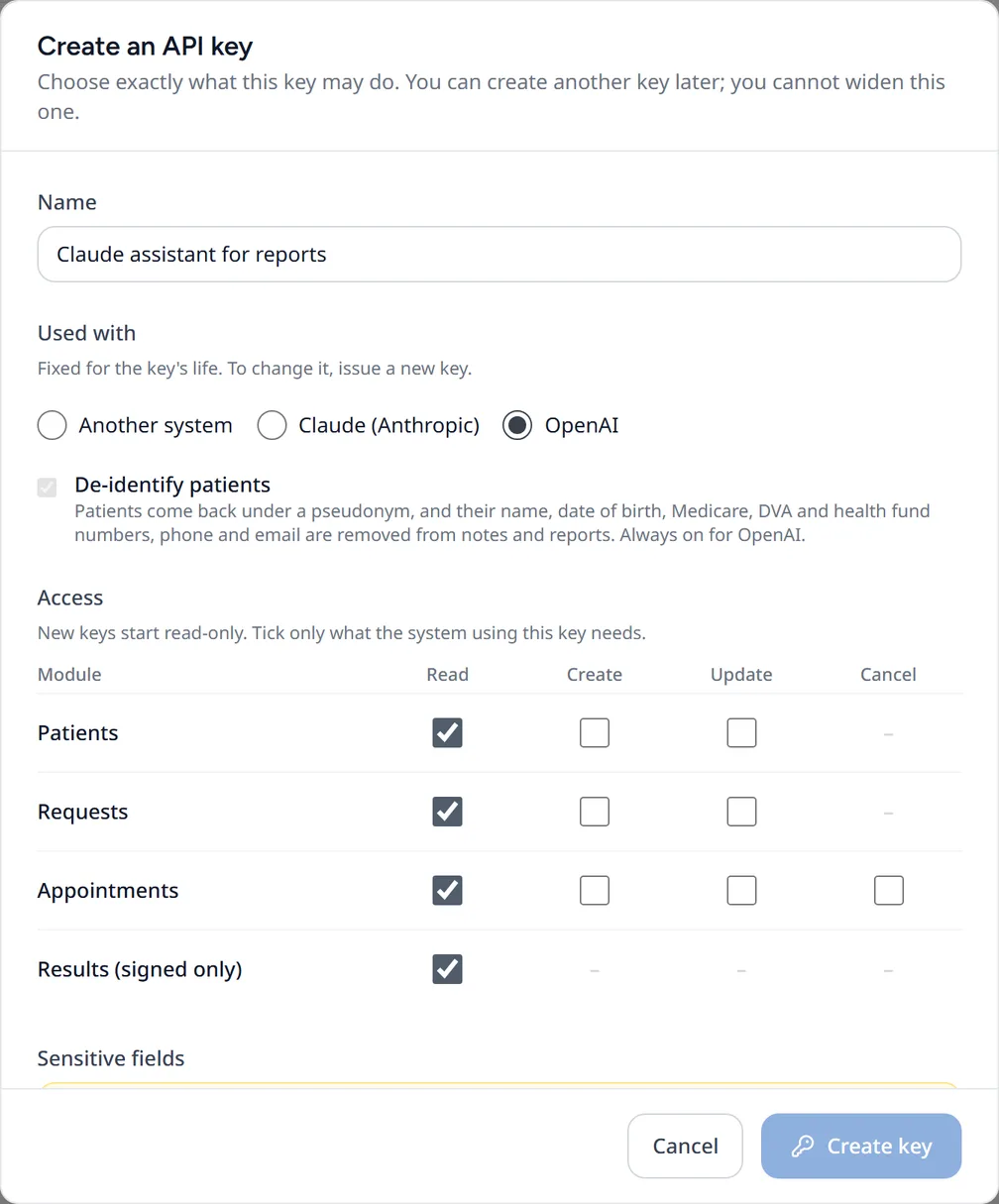
- A key used with OpenAI is always de-identified.
- Any other key can be marked de-identified when it is created.
What a de-identified key changes
Clarirad's servers apply de-identification before the response leaves Clarirad. It is not done by the MCP server, so a modified MCP server, or a direct call to the API with the same key, cannot get around it.
- Names: the patient's title and first, middle and last names are replaced by a pseudonym. The first name becomes
Patientand the last name an 8-character code. The code is the same for that patient every time within your tenant, so the AI app can tell patients apart and refer back to one. - Free text: in patient notes, allergies and history; request clinical history, indication and notes; appointment notes; and result findings, impression, recommendations and report text, the patient's details as recorded on the patient's record are replaced. Name words become
[patient], the date of birth[date of birth], Medicare, DVA and health fund numbers[identifier], phone numbers[phone]and the email address[email]. - Identifiers: the
patients:identifiersscope (date of birth, Medicare, DVA and health fund details, and contact details) cannot be granted to a de-identified key. - Search: patient search matches the MRN only.
- Writes: the key cannot set or change patient names. It therefore cannot register patients, which needs a date of birth as well.
The MRN is still returned, so your staff can find the patient in Clarirad. Every response to a de-identified key carries the header X-Clarirad-Deidentified: true.
What de-identification does not cover
- Staff, referrer and radiologist names are not changed.
- Details typed into free text that are not on the patient's record can still pass through: a relative's name, an address, or a date written in a format Clarirad does not recognise.
- A word from the patient's name is replaced wherever it appears, even as an ordinary word. For a patient named White, "white matter" in a report becomes
[patient] matter. This favours privacy over the exact wording of the text. - Anything you type into the AI app yourself, such as a patient's name in your prompt, goes to that provider whatever the key is.
- A Claude key that is not marked de-identified returns real names and the other fields its scopes allow. They go to the AI app and on to Anthropic.
Before you connect patient data
Review your agreement with any AI provider before you connect a key that can return patient information. De-identification reduces what reaches the provider; it does not decide whether your use of that provider is permitted.
- Grant only the scopes the task needs, and confine the key to the sites it needs.
- Mark the key de-identified unless the task needs real names.
- Keep the IP allowlist to the machines that run the MCP server.